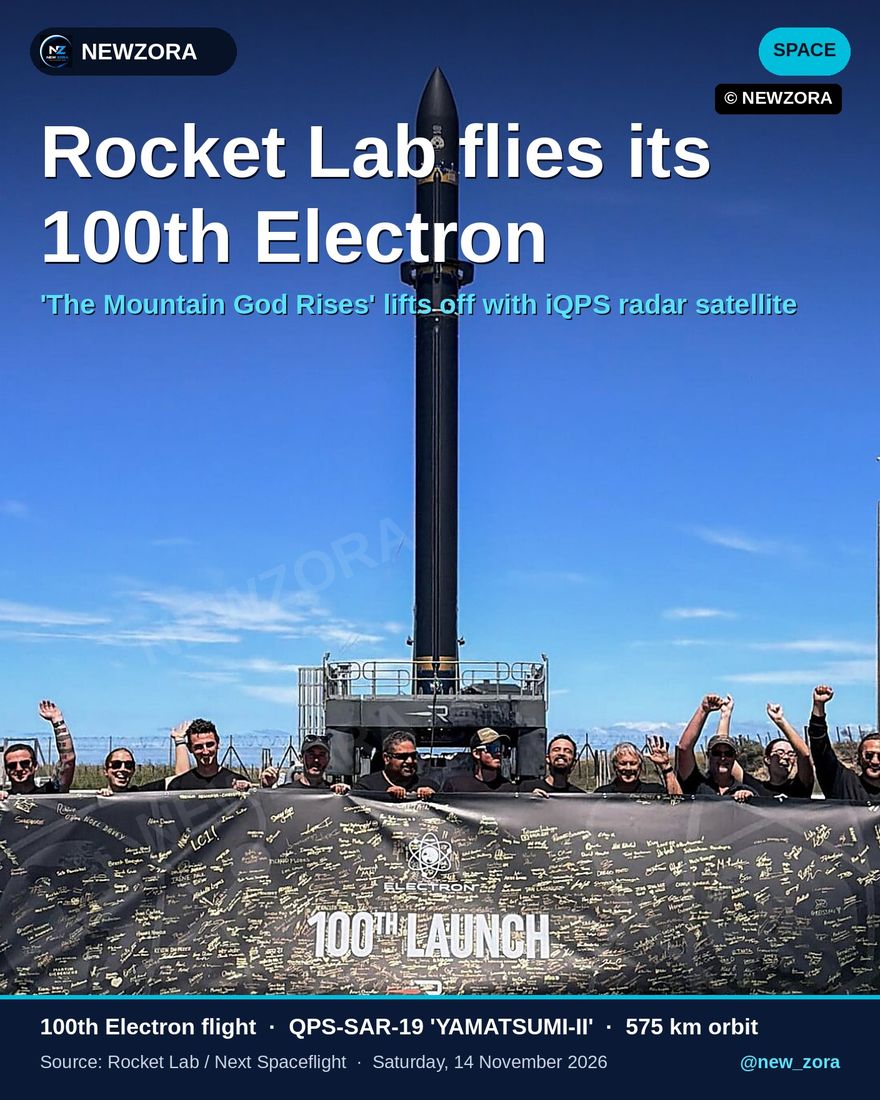
Rocket Lab flies its 100th Electron
The mission
The payload was a single satellite, QPS-SAR-19, nicknamed "YAMATSUMI-II", built and operated by the Institute for Q-shu Pioneers of Space, known as iQPS, a Fukuoka-based Earth-observation company. The spacecraft is a synthetic aperture radar satellite, a type of sensor that produces images of the ground through cloud cover and at night, when optical cameras cannot operate. Rocket Lab stated that the satellite was bound for a circular low Earth orbit at an altitude of 575 kilometres and an inclination of 42 degrees, the same orbital regime used by the preceding iQPS mission.
Payload deployment took place approximately 50 minutes after liftoff, at about 12:20 in Dhaka. Rocket Lab confirmed mission success in a press release issued later on 14 November 2026, stating that QPS-SAR-19 "YAMATSUMI-II" had been deployed to its planned 575-kilometre low Earth orbit. According to the release, the flight was the 11th dedicated Electron mission for iQPS since 2023, and Rocket Lab reports a 100 per cent mission-success record across those flights. iQPS has booked seven further dedicated Electron launches through 2030, the release added.
A milestone flight
Rocket Lab counts "The Mountain God Rises" as the 100th flight of Electron, its two-stage small-lift vehicle. The company describes the achievement as an unprecedented milestone for a commercial small-lift orbital rocket, and says Electron reached 100 launches faster than any other commercially developed rocket, a claim that rests on the company's own count of its flight history. Electron is capable of delivering up to 300 kilograms to low Earth orbit and 200 kilograms to Sun-synchronous orbit, according to NASASpaceFlight, and its first stage is powered by nine Rutherford engines, which Rocket Lab describes as the first 3D-printed orbital rocket engines, driven by electric fuel pumps rather than gas generators.
To mark the occasion, the vehicle flew in a special black, white and gold livery, distinct from the standard black-and-white scheme. Before liftoff, members of the launch team posed with a banner reading "100TH LAUNCH", signed by staff, in front of the vehicle on the pad at Launch Complex 1. The mission patch features Mount Fuji, a reference to the satellite's name, and stars representing the number of QPS-SAR satellites previously launched by Electron.
The customer and the constellation
The flight was the 11th dedicated Electron mission for iQPS since 2023, according to Rocket Lab, making the Japanese operator one of the most frequent customers in Electron's history. The previous mission in the series, "The Sea God Surveys", flew on 2 November 2026 and carried QPS-SAR-20, nicknamed "WADATSUMI-II", to the same 575-kilometre orbit. That flight was Electron's 99th and its 20th mission of 2026.
The numbering of the two satellites illustrates a detail of iQPS practice: satellite numbers are assigned in the order in which launches are contracted, not the order in which they fly, so QPS-SAR-20 launched before QPS-SAR-19 because it was ready first. The names follow a pattern drawn from Japanese mythology. "YAMATSUMI-II" refers to the mountain guardian deity, and the spacecraft is the second satellite in the same orbital plane as the earlier "YAMATSUMI-I". The mission name, "The Mountain God Rises", draws on the same reference.
iQPS is building a constellation of small synthetic aperture radar satellites intended to provide high-resolution, near-real-time radar imagery to global users. The company plans to operate 24 satellites by the end of May 2028, and its stated target configuration is 36 satellites arranged in four orbital planes of nine, which it says would allow any point on Earth to be revisited at intervals of 10 minutes or less. The company describes the ground resolution of its satellites as 46 centimetres, which it presents as world-leading among commercial small radar systems. As of August 2026, iQPS reported approximately 10 operational satellites, with roughly 18 launched in total.
Why the milestone matters
One hundred flights is a threshold that few launch vehicles of any size have reached, and it is rarer still for a small-lift rocket operated by a commercial company. The cadence behind the number is the more significant measure: Electron's 99th flight took place only 12 days before the 100th, and the vehicle flew 20 missions in 2026 before this flight. That rate reflects a launch operation that has moved from proving the vehicle to running it as a routine service, with a manifest dominated by repeat customers such as iQPS, for which Rocket Lab says it is the primary launcher.
The milestone also illustrates the economics of dedicated small launch. A satellite of the 100-kilogram class, such as QPS-SAR-19, could in principle fly as a secondary payload on a larger rocket, but a dedicated Electron flight gives the operator control over the launch date and the exact orbital plane, which matters when a constellation must be filled plane by plane. iQPS has seven further dedicated Electron flights booked through 2030, according to the mission-success release, which indicates that the company intends to continue buying dedicated launches rather than rideshares.
What comes next
With deployment confirmed, iQPS will commission the satellite's radar antenna and bring it into service alongside the rest of the constellation. The next test for Rocket Lab is the pace at which it can sustain its 2026 flight rate into 2027, and the progress of Neutron, its larger reusable vehicle, which is intended to carry heavier payloads that Electron cannot.
Source
Rocket Lab mission-success press release, 14 November 2026 (GlobeNewswire); Rocket Lab mission page and press release, 12 November 2026 (GlobeNewswire); Rocket Lab YouTube launch broadcast, 14 November 2026; iQPS mission notice, 14 November 2026; Next Spaceflight mission data; TechTimes, 4 November 2026.
More in Space
Vulcan fails — ULA's first total mission loss: 40 Amazon Leo satellites lost

Vulcan returns to flight — Amazon Leo 1 launches after two scrubs