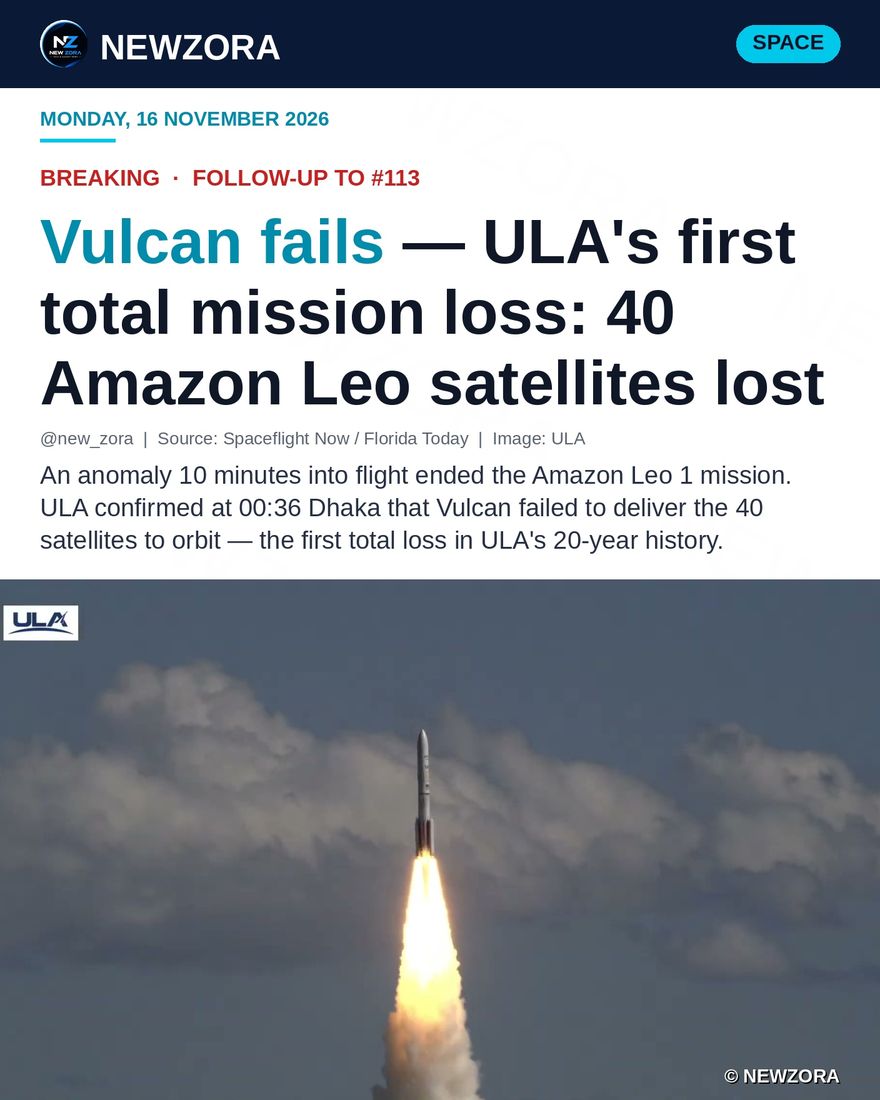
Vulcan returns to flight — Amazon Leo 1 launches after two scrubs
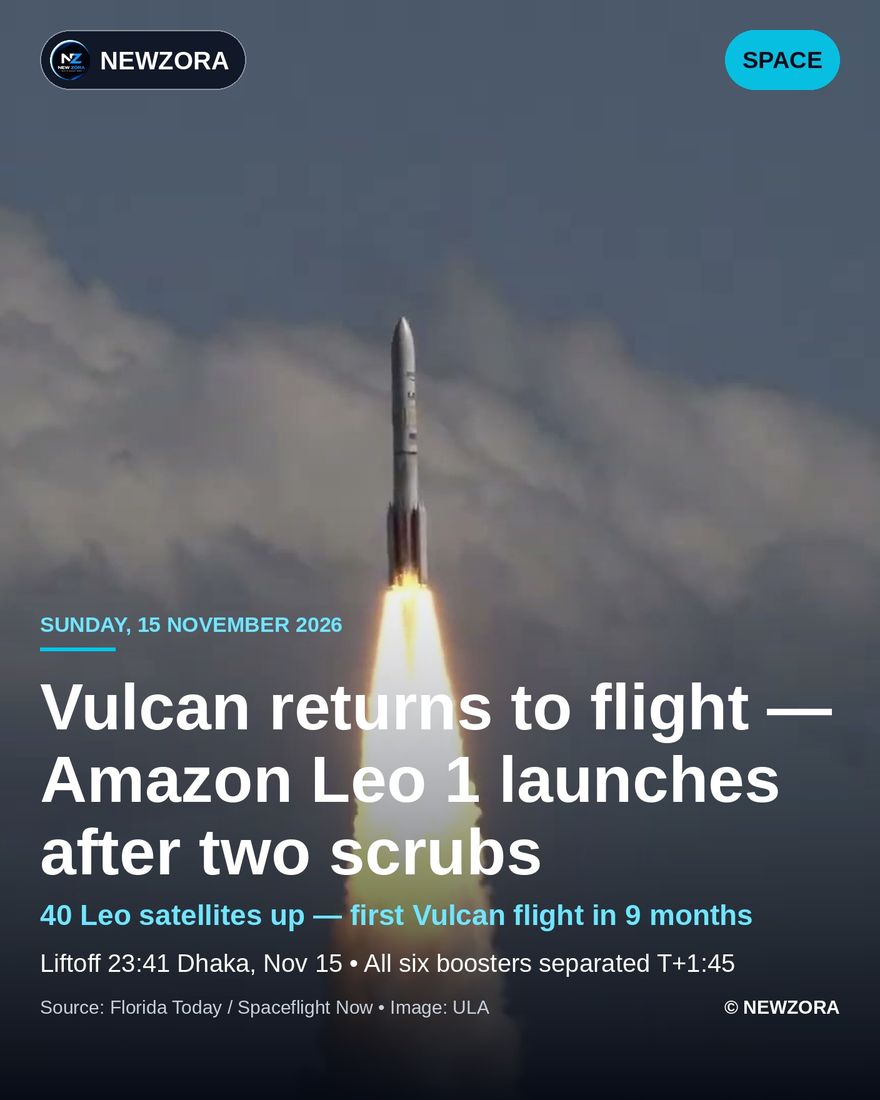
Florida Today, which covered the launch in a live blog, reported liftoff at 12:41 p.m. Eastern Time and noted that Brevard County deactivated its launch support at 12:57 p.m. Eastern Time after the successful liftoff. The 40 satellites aboard the flight represent the largest number of Amazon Leo spacecraft carried on a single mission to date, according to United Launch Alliance and Amazon.
Liftoff after two scrubbed attempts
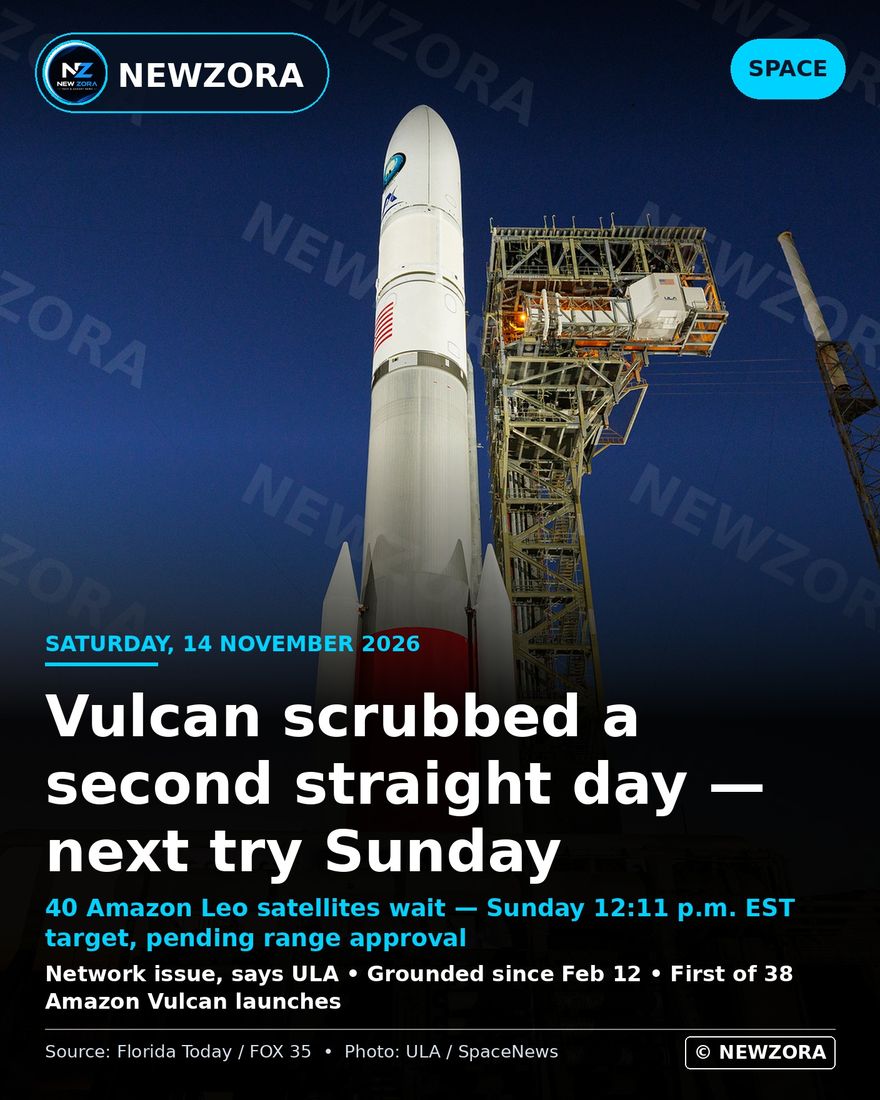
The mission reached the launch pad only after two consecutive postponements. The first attempt, on Friday, November 13, was scrubbed after a power interruption at the Air Liquide gaseous nitrogen plant caused the loss of high-pressure pumps required for the countdown. The second attempt, on Saturday, November 14, was scrubbed after a network communication issue arose between ground equipment and the launch vehicle. According to United Launch Alliance, reconfiguring the connection would have extended the hold beyond the 29-minute launch window, and the attempt was called off.
The third attempt opened with the same 29-minute window, from 12:11 p.m. to 12:40 p.m. Eastern Time. After a late-countdown hold, the rocket lifted off at 12:41 p.m. Eastern Time, or 11:41 p.m. Bangladesh Standard Time. The flight used the Vulcan VC6L configuration, the most powerful variant of the rocket, which stands 215 feet tall and generates 3.9 million pounds of thrust with six solid rocket boosters mounted alongside the core stage, according to Florida Today.
All six solid rocket boosters separated at approximately one minute and 45 seconds after liftoff, at an altitude of about 22 miles, as planned. The Centaur V upper stage then continued the flight toward the deployment orbit.
Return to flight after the February anomaly
Amazon Leo 1 was the first Vulcan flight since February 12, 2026, when a booster nozzle anomaly occurred during the USSF-87 mission. During that flight, one of four solid rocket boosters suffered a nozzle burn-through approximately 20 seconds after liftoff. The United States Space Force subsequently paused Vulcan for national-security missions pending a fix for the problem.
The pause applied to national-security missions. Amazon Leo 1 is a commercial flight, and it proceeded after United Launch Alliance completed its investigation and corrective work. The mission therefore served as the rocket's return to flight, nine months after the anomaly, rather than the end of a blanket grounding of the vehicle.
The deployment plan for 40 satellites
According to United Launch Alliance, as reported by Florida Today, the Centaur V upper stage was to begin a 50-minute coast period after reaching an elliptical orbit, followed by a brief second firing of its engines to circularize the orbit at an altitude of approximately 285 miles. The satellite deployments were scheduled to begin about 70 minutes after liftoff, at approximately 12:51 a.m. Bangladesh Standard Time, and to last about 25 minutes as the upper stage crossed the Pacific Ocean.
In total, 16 separation events were planned to release the 40 satellites from the customer-provided dispensing system riding atop the Centaur V. At the time of writing, no confirmation of completed deployment had been published by United Launch Alliance or by the reporting outlets covering the mission, and the deployment should be understood as scheduled rather than completed.
A long programme for Amazon Leo
Amazon Leo, formerly known as Project Kuiper, is Amazon's low Earth orbit broadband constellation, operated by Kuiper Systems LLC, a subsidiary of Amazon. The constellation is planned to include more than 3,200 spacecraft, and the Federal Communications Commission expects 3,232 first-generation satellites to be in orbit by July 2029.
Amazon Leo 1 is the first of 38 planned Vulcan launches for Amazon. United Launch Alliance has stated that Vulcan will launch more than 1,500 first-generation Leo satellites across those flights. The 40 satellites on this mission add to a constellation that, according to reporting on the mission, already had 368 satellites in their operational orbit in early November, with six satellites having reentered the atmosphere to date.
The scale of the programme makes Vulcan's reliability a commercial question as well as a technical one. Amazon has booked launches across multiple providers, but the 38 Vulcan flights represent the largest single share of its deployment plan, and the pace of those flights will determine how quickly the constellation reaches the 578 satellites that Amazon Leo needs in orbit to begin initial regional service.
Why it matters
The launch restores United Launch Alliance's newest rocket to service after its longest interruption and opens the largest deployment campaign in the company's history. For Amazon, it is the first step in moving the Leo constellation from early deployment toward the scale required for commercial service. For the launch market, it returns a second heavy-lift option to regular service alongside SpaceX, at a moment when demand for large constellation launches remains high.
The mission also demonstrates the value of the corrective work that followed the February anomaly. A clean ascent, including the planned separation of all six solid rocket boosters, provides the first flight evidence that the fix holds under the most demanding configuration of the vehicle. The remaining test is the deployment itself, which was scheduled to conclude about 95 minutes after liftoff.
Sources: Florida Today live blog, Spaceflight Now, United Launch Alliance, Amazon.