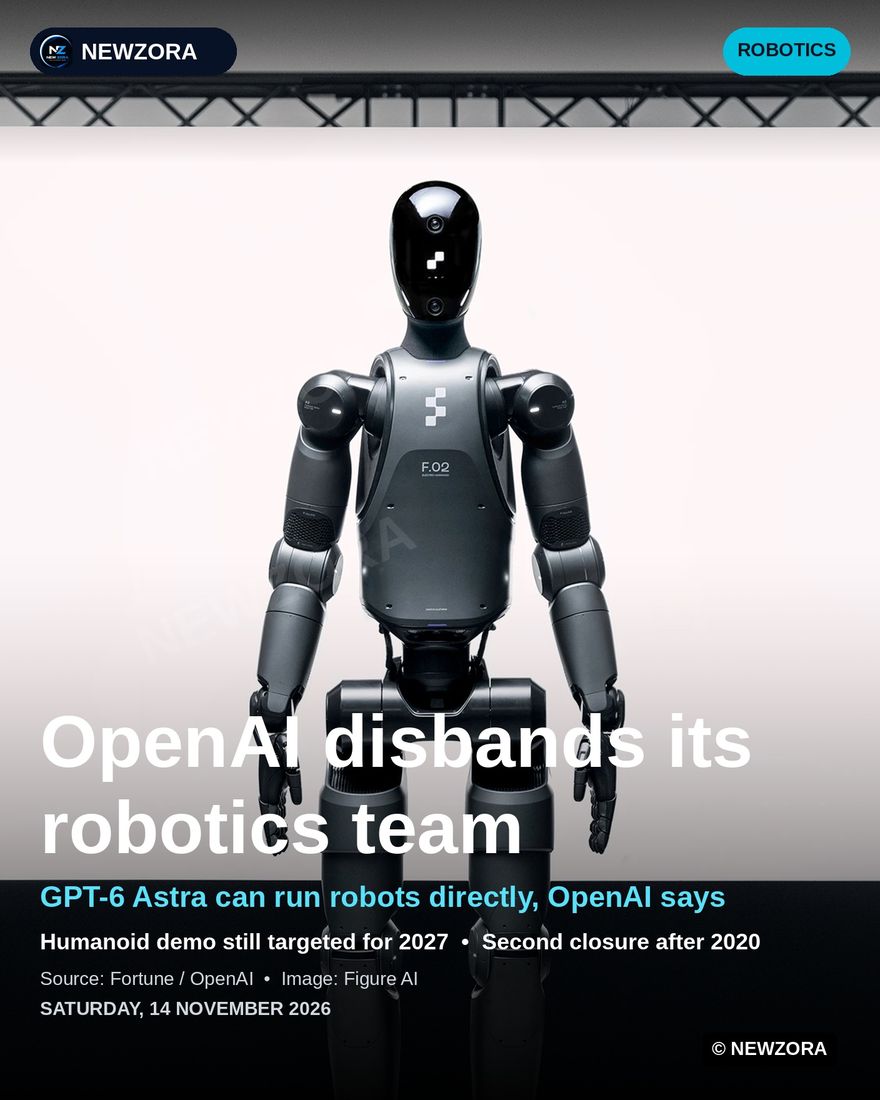
OpenAI disbands its standalone robotics team, betting GPT-6 Astra can run robots directly
The reorganisation
Under the new structure, robotics research staff move to the main research organisation, led by Chief Research Officer Mark Chen. Applied robotics and hardware staff move to the Applied organisation, led by President Greg Brockman. The change was confirmed by an OpenAI spokesperson to Fortune. The company has not published a blog post or a statement of its own on the reorganisation, and the public record of the decision rests on the Fortune report and the spokesperson statement it contains. OpenAI did not disclose how many staff members are affected by the move.
The structure that has been dissolved was a standalone team dedicated to building robot models. Its work is now distributed between the two organisations that already carry the company's core model research and its applied product work. The reorganisation does not create a new robotics division. It removes the separate team and places its staff inside the groups that develop and deploy the company's general-purpose models.
The stated rationale
OpenAI stated that general-purpose frontier models, including GPT-6 Astra, can now be applied to robots directly, and that a separate team building dedicated robot models is therefore no longer the best structure. The reasoning marks a change from the position held at the start of 2026, when researchers at the company assumed that the route to capable robots ran through video models such as Sora. Since then, according to the company, general models have proved able to work directly on robots, which removes the need for a distinct modelling effort for robotics.
The claim rests on a shift in how robot control is approached. A dedicated robot model is trained specifically for physical tasks, using robot data. A general-purpose model is trained across text, images, video and other data, and is then applied to robot control without a separate model built for that purpose alone. OpenAI now holds that the second approach is sufficient.
Simulation evidence
The evidence cited for the change comes from simulation, not from physical robots. In a simulation benchmark named RoboLab-120, GPT-6 Astra Agentic Policy scored 74.8 percent, compared with 51.0 percent for the best dedicated robot model, identified as Lakeside. The benchmark ran on RoboLab 1 with a DROID robot, and the simulation was paused during inference. Each inference call took 18.56 seconds.
These figures require careful interpretation. A simulation result measures performance in a controlled virtual environment, where the robot, the objects and the physics are all modelled. It does not demonstrate that the same model controls a physical robot with the same reliability, speed or safety. The 18.56-second inference time is also a material constraint: a robot that pauses for more than 18 seconds before each action moves slowly in any real setting. The benchmark supports the claim that a general-purpose model can outperform a dedicated model on a defined simulation task. It does not establish that GPT-6 Astra already operates robots in production.
A second closure
The history of the team gives the decision additional context. OpenAI first wound down a robotics group in 2020. Cofounder Wojciech Zaremba cited limited robot data as the reason at the time. The field then faced a shortage of the large, varied datasets that had driven progress in language and vision models, and the company concluded that the robotics effort could not advance at the pace it required.
The team was rebuilt in 2024, when the company returned to robotics alongside a partnership with Figure. That partnership ended in February 2025, when Figure chose to build its own robot artificial intelligence rather than continue working with OpenAI. The rebuilt team therefore operated for less than two years before this second closure, and its dissolution follows the end of the partnership that accompanied its creation.
What remains unchanged
An OpenAI spokesperson told Fortune that robotics remains a core part of the company's long-term vision, and that the split is meant to speed its robot plans up rather than slow them down. The company continues to target a humanoid robot demonstration in 2027, according to Chief Executive Officer Sam Altman. The reorganisation, on the company's account, is a change in where robotics work sits inside OpenAI, not a change in whether the work continues.
A small detail reported by Fortune adds colour to the announcement. OpenAI had registered booth 208 at the Conference on Robot Learning in Austin during the same week. Fortune found the booth empty, with no OpenAI logo on display.
Why it matters
The decision is significant because it tests a central assumption about how robots will become capable. If general-purpose models can control robots directly, then the companies that build the strongest general models gain an advantage in robotics without needing to build separate robot-specific systems. That would concentrate progress in the hands of a small number of frontier model developers and reduce the value of dedicated robot modelling as a separate discipline.
The opposite reading is also available. The simulation benchmark is narrow, the inference time is long, and the history of the field includes a previous closure that was driven by a lack of data. A general model that scores well in simulation may still struggle with the physical realities of manipulation, balance and safety. If the direct application of general models to robots proves slower or less reliable than expected, OpenAI will have dissolved the team that specialised in the alternative approach.
Fortune also notes, as business context, that OpenAI reported a quarterly operating loss of 10.9 billion dollars. That figure is context for the company's financial position. It is not presented as a reason for the reorganisation, and no evidence links the two.
What happens next
The immediate consequence is organisational. Robotics researchers now report through the main research organisation under Mark Chen, and applied robotics and hardware staff through the Applied organisation under Greg Brockman. The 2027 humanoid demonstration target remains the nearest public test of whether the new structure delivers. A demonstration in that year would show whether general-purpose models, applied directly, can produce a capable humanoid robot on the timetable the company has set.
The longer test is whether the simulation results transfer to physical robots. Benchmarks in simulation are a starting point, not a conclusion. The field will measure progress by physical demonstrations, by deployment in real environments, and by whether inference times fall to levels that allow fluid, continuous robot behaviour. Until those results appear, the claim that GPT-6 Astra can run robots directly remains a statement of direction supported by simulation evidence, not a demonstrated fact about physical robots.
Source: Fortune exclusive by Wen Shao, 13 November 2026; OpenAI spokesperson confirmation to Fortune; NVIDIA research page for the benchmark leg.