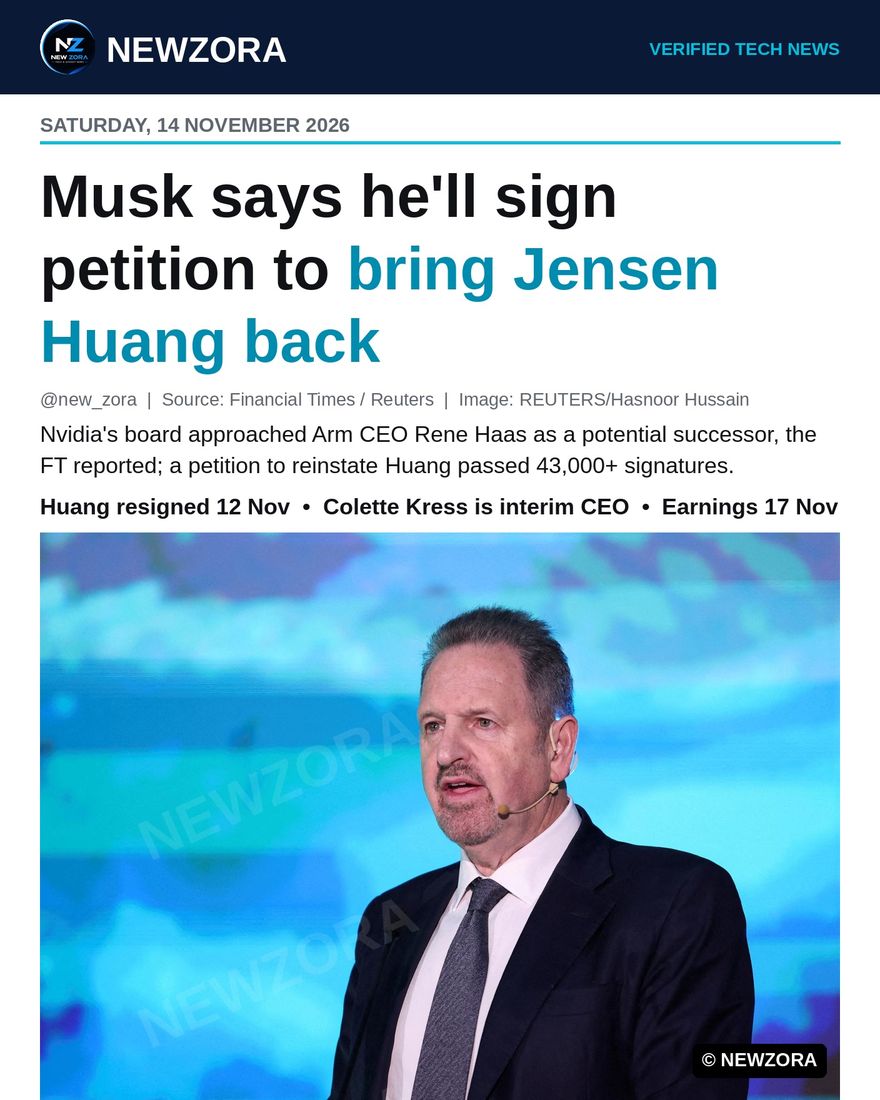
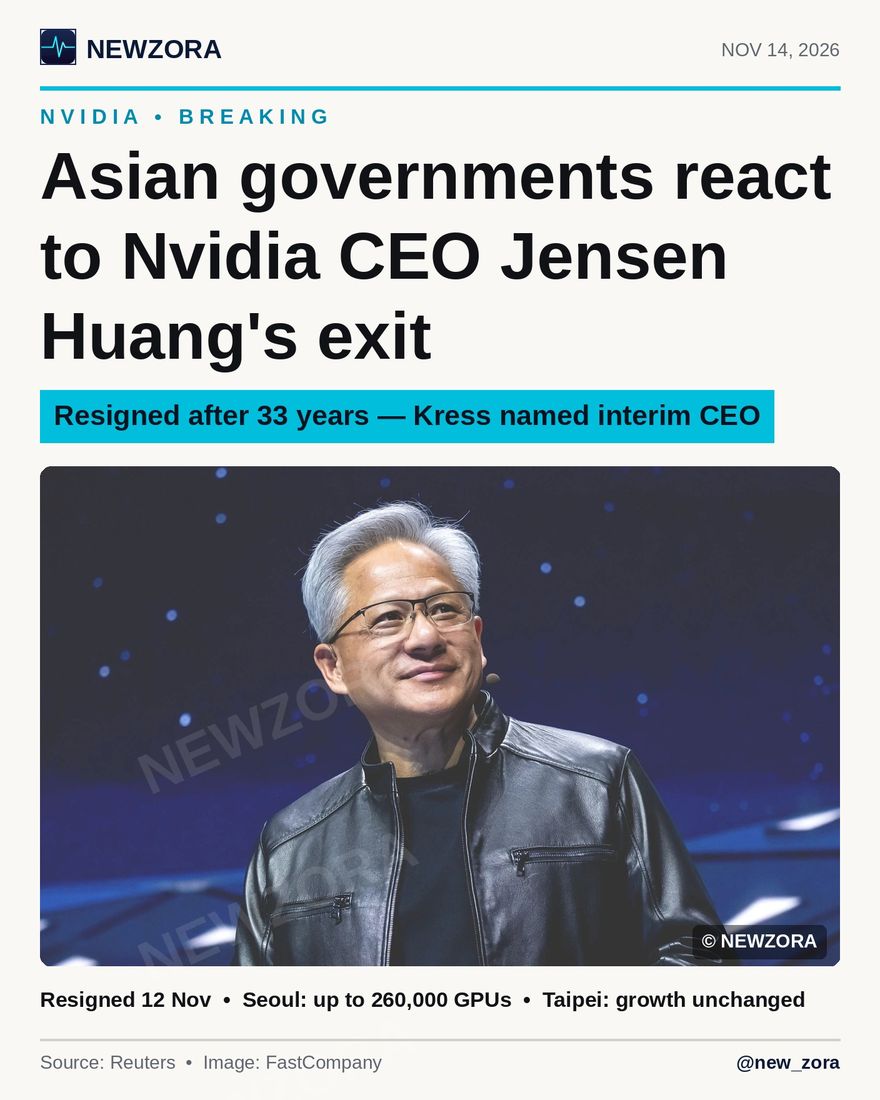
Asian governments react to Nvidia CEO Jensen Huang's exit
The resignation
Huang resigned as chief executive of Nvidia on Thursday 12 November 2026, effective immediately, after 33 years in the role. He also stepped down as president and as a member of the board of directors. Chief Financial Officer Colette Kress was named interim chief executive. Nvidia gave no reason for the departure. According to the company's filing with the United States Securities and Exchange Commission, the resignation was accepted on 11 November. The filing does not record a reason, and the company has not issued a further explanation.
The departure ends one of the longest tenures of any chief executive in the semiconductor industry. Huang co-founded Nvidia in 1993 and led the company into its position as the dominant supplier of the accelerators on which modern artificial intelligence systems are trained and run. That dominance is the reason the resignation registered as a policy event rather than a corporate one.
South Korea: reassurance and emergency meetings
South Korea moved first and most visibly. Science Minister Bae Kyung-hoon said that Nvidia had confirmed its commitment to deploy up to 260,000 graphics processing units in the country, a plan that dates to October 2025 and was announced around the Asia-Pacific Economic Cooperation summit in Gyeongju. The minister made the statement in a Facebook post following a meeting between the ministry and Nvidia.
The government also convened two emergency meetings on Friday 13 November. The first was held by the Science Ministry in the morning, chaired by Second Vice Minister Ryu Jemyoung, who spoke directly with the head of Nvidia Korea. The second was convened by the National AI Strategy Committee.
The attribution matters. The reaffirmation of the 260,000-unit commitment came from Minister Bae and from the ministry meeting. Nvidia itself has issued no statement on its South Korea plans since the resignation.
Taiwan: continuity at the Taipei headquarters project
In Taiwan, Economy Minister Kung Ming-shin said on 12 November that artificial intelligence development is a global trend that will not materially change because of one person's movements. The statement was measured, and it was consistent with the government's broader position that the structural demand for computing capacity is independent of any single executive.
The Taipei City government addressed the more concrete question of Nvidia's planned overseas headquarters at the Beitou-Shilin Technology Park. It said that Nvidia's Taiwan subsidiary is meeting all of its contractual obligations for the project. The land contract has been signed, the performance bond, premium and rent have been paid, and the foundation plans were approved on 5 November. The city government said it does not expect a change of chief executive to affect those obligations.
Japan: monitoring, not judgement
Japan's response was the most cautious of the four governments. Ryosei Akazawa, the Minister of Economy, Trade and Industry, described Nvidia as an extremely important entity and said the ministry will closely monitor future developments. Masanao Ozaki, the Deputy Chief Cabinet Secretary, said it was too early to judge the impact of the resignation and that the government will continue to monitor developments, stressing the importance of a stable supply of artificial intelligence and semiconductor products.
Neither statement committed Japan to any change in policy. Both framed the resignation as an event to be watched rather than an event to be answered.
Singapore: the Alice Huang case clarified
Singapore's Ministry of Home Affairs addressed a separate but related matter: the case of Alice Huang, whose name has appeared in reporting on the movement of Nvidia hardware. According to the ministry, police impounded her passport on 24 June 2025, the same day as the police interview, to secure her attendance at proceedings. In February 2026, investigators found insufficient evidence on the suspected false declarations relating to server purchases. She was issued a stern warning and barred from re-entering Singapore.
Two details in the ministry's account correct the public record. First, her passport was returned on 26 February 2026, and she left Singapore the same day. Second, she was not investigated for espionage. The probe concerns suspected false declarations on server purchases, not spying. The investigation into Megaspeed and six other parties remains ongoing.
China: rejection of the spy allegations
Beijing has repeatedly rejected the espionage allegations. On 12 November, foreign ministry spokesperson Mao Ning called on those making the claims to "stop fabricating the Chinese spy narratives as a pretext for imposing technology blockades". The allegation that the company was involved in espionage remains a suspicion voiced by United States officials and reported in the press. It has not been established as fact, and this article presents it only as an allegation.
The scale of exposure: the Reuters review
A review published by Reuters on 13 November gives a measure of the commercial exposure involved. The review identified more than 3 billion dollars in Chinese computing projects built around Nvidia's restricted processors, based on procurement notices, investment plans and corporate disclosures. One example cited in the review is a 6.2 billion yuan computing centre in Fujian province that specifies H100 processors.
The figure should be read with care. It is a Reuters review finding, based on public documents. It is not a measure of confirmed losses, and it does not prove that any of the projects identified are at risk. What it establishes is the scale of the installed base and the pipeline that depends, directly or indirectly, on Nvidia hardware.
Why it matters
The responses from Seoul, Taipei, Tokyo, Singapore and Beijing share a common premise: Nvidia's hardware is now treated as strategic infrastructure, and a leadership change at the company is therefore a matter of public concern in every country that depends on it. South Korea's emergency meetings and Taiwan's statement on contractual obligations both show governments seeking to confirm, in public, that existing commitments still hold.
The episode also illustrates the limits of what a government can confirm in the first days after a resignation. Nvidia has given no reason for Huang's departure and has issued no statement on its country-level plans since the announcement. The reassurances issued so far have come from governments, not from the company.
What happens next
Three developments will determine how the story proceeds. First, Nvidia must appoint a permanent chief executive, and the identity and background of that appointment will shape how governments and customers assess the company's direction. Second, the deployment commitments in South Korea and the headquarters project in Taiwan will be watched for any sign of delay. Third, the investigation in Singapore and the broader dispute over the movement of restricted processors into China remain unresolved.
Sources: TechCrunch, 14 November 2026; Reuters; Al Jazeera; The Register; Yonhap; The Korea Times; Korea JoongAng Daily; Focus Taiwan; Central News Agency; UDN; TBS News DIG; Economic Times.
More in AI
Microsoft signs Cerebras as third hyperscaler
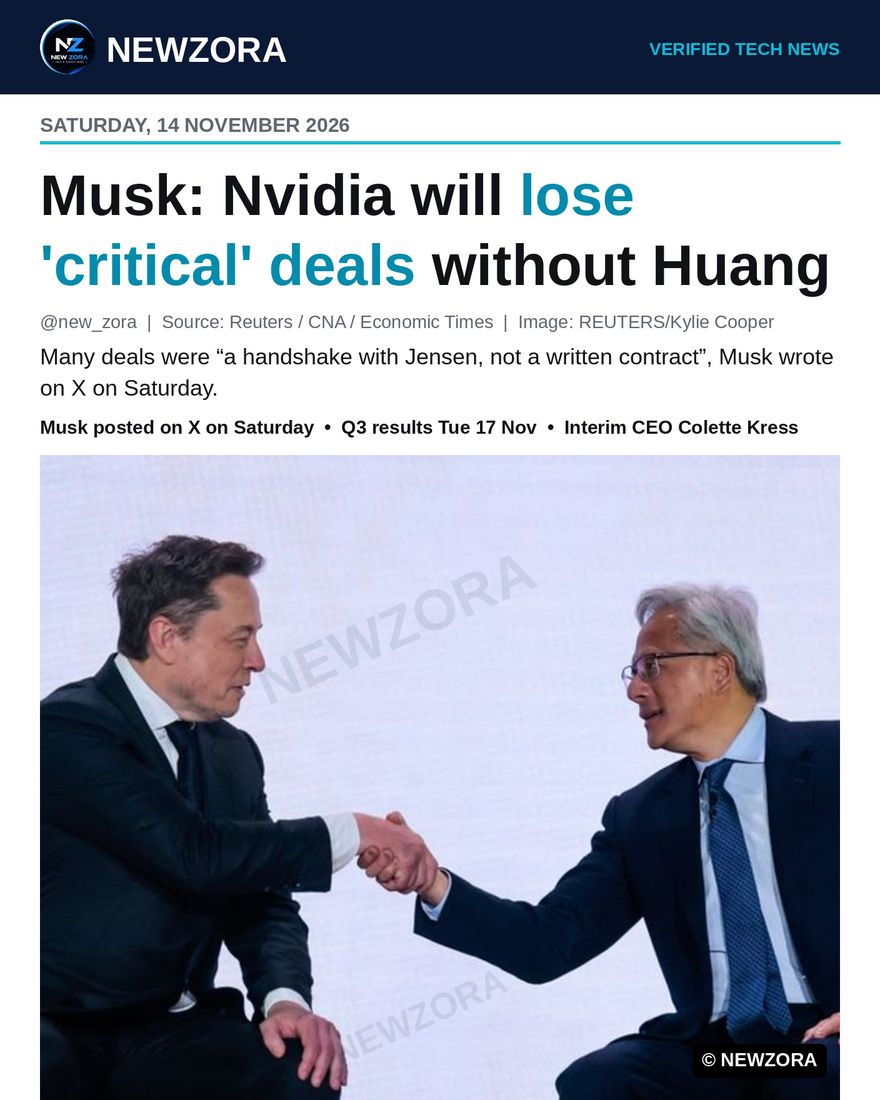
Musk: Nvidia will lose 'critical' deals without Jensen Huang