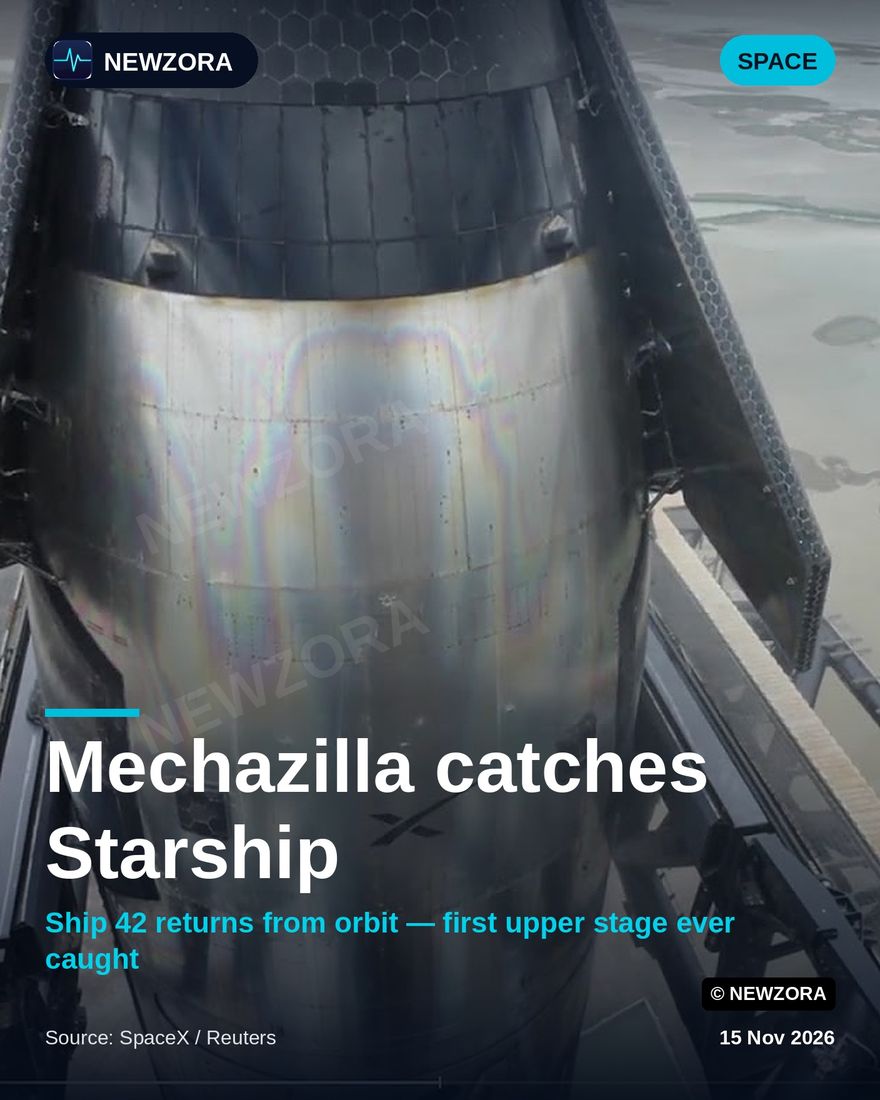
SpaceX cleared for first double catch as Starship Flight 15 licence issued
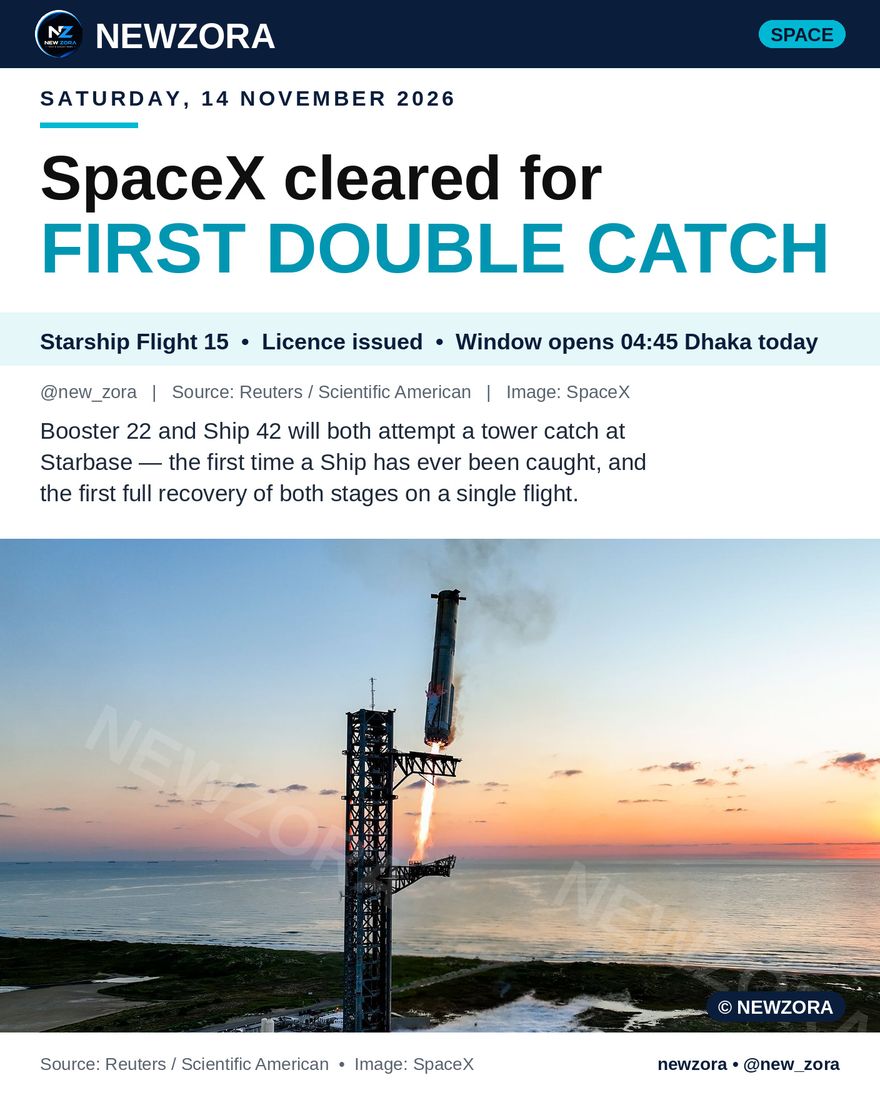
SpaceX's own mission page had not been updated at the time of writing and continued to describe the flight as pending regulatory approval. That description is stale. The licence has been issued, and the flight may proceed within the stated window, subject to weather and vehicle readiness. SpaceX has also noted that its schedule remains dynamic, and the timing may change.
The vehicles
Flight 15 will fly Super Heavy Booster 22 and Ship 42, the latter named "Don't Panic". Both vehicles are Block 3 hardware, and the pairing is the fourth Block 3 pair to fly. Block 3 represents the current production configuration of the Starship system, and the flight is a further step in the programme of incremental testing through which SpaceX has developed the vehicle.
The mission profile calls for the vehicle to reach an orbit of approximately 275 kilometres and to complete approximately 14 orbits over a period of more than 22 hours. The booster is scheduled to return to the launch tower approximately 6.5 minutes after liftoff. The Ship is scheduled to return to the tower approximately 22.5 hours after liftoff, which, at a window-open liftoff, corresponds to approximately 21:17 UTC on November 14, or approximately 03:17 in Dhaka on November 15. The exact time of the Ship's return will shift with the actual liftoff time within the launch window.
The double catch
The central objective of Flight 15 is the recovery of both stages. The Super Heavy booster will attempt a catch by the tower's mechanical arms, a manoeuvre SpaceX has completed three times before, between October 2024 and March 2025. The Ship will attempt a catch at the tower for the first time. No Starship upper stage has previously been caught.
If both catches succeed, Flight 15 will be the first occasion on which both stages of an orbital rocket have been recovered on a single flight. SpaceX has described the objective as "the first full recovery of an orbital launch system". The claim is significant because the recovery of both stages, rather than the booster alone, is the condition for the fully reusable launch system that the Starship programme is designed to deliver.
The Ship catch is the more demanding of the two attempts. The Ship must survive re-entry through the atmosphere, including the heating of its heatshield, and then arrive at the tower with sufficient precision for the arms to secure it. SpaceX has fitted three of the payload satellites on this flight with cameras to inspect the heatshield during flight, a measure that reflects the attention given to the thermal protection system on this mission.
The payload
Flight 15 will carry 26 Starlink V3 satellites. It is the second operational Starlink flight on Starship. According to SpaceX, each V3 satellite adds 1 terabit per second of capacity to the Starlink network. The deployment of the satellites is the operational purpose of the flight, alongside the recovery objectives, and it follows the first operational Starlink deployment on Starship during Flight 14.
Flight 14 in context
Flight 14, flown on September 28, 2026, was Starship's first orbital flight and its first operational Starlink deployment. The flight ended early with a splashdown in the Pacific Ocean after an engine shutdown, and no Ship catch was attempted on that mission. Flight 15 therefore carries forward the orbital and deployment objectives demonstrated in part by Flight 14, while adding the Ship recovery attempt that Flight 14 did not include.
The sequence illustrates the programme's method of testing one new capability at a time. The booster catch was demonstrated before the Ship catch was attempted, and the first orbital flight and first operational deployment preceded the first attempt at a full two-stage recovery.
Why it matters
The recovery of both stages matters for three reasons. First, reusability is the economic foundation of the Starship programme. A launch system in which both stages return and fly again can, in principle, reduce the cost of access to orbit by an order of magnitude relative to expendable vehicles, although the actual cost reduction depends on the refurbishment required between flights, which SpaceX has not disclosed.
Second, the flight tests the heatshield and re-entry performance of the Ship under operational conditions, with a payload of 26 satellites and a full-duration orbital mission of more than 22 hours. The data gathered, including the imagery from the three camera-carrying satellites, will inform the design of subsequent Block 3 vehicles.
Third, the flight advances the deployment of the Starlink V3 constellation. Each V3 satellite adds 1 terabit per second of capacity, according to SpaceX, and the constellation is the revenue-generating application that funds the Starship programme. The second operational Starlink flight on Starship is therefore both a test and a commercial operation.
What happens next
The launch is scheduled within the window opening at 04:45 in Dhaka on Saturday, November 14, 2026. The booster catch is expected approximately 6.5 minutes after liftoff. The satellite deployment and the long orbital phase will follow, with the Ship catch expected approximately 22.5 hours after liftoff, in the early hours of November 15 in Dhaka, if the flight proceeds at the opening of the window.
The outcome of the flight has not yet been determined. The licence has been issued and the window is open, but the launch has not taken place, and the two catches remain attempts, not achievements. The results, including whether the Ship is recovered at the tower, will be known only after the flight.
A note on the image
The photograph accompanying this article is a SpaceX file photograph of an earlier Super Heavy booster catch at Starbase. It shows a booster being caught by the tower arms at sunset. It is not a photograph of Flight 15 hardware, and it does not depict the Flight 15 launch, which has not yet taken place. It is reproduced to illustrate the booster-catch manoeuvre that Flight 15 will attempt, and that the flight will attempt for the first time with the Ship as well.
Source: Reuters / CNA; Scientific American; Federal Aviation Administration licence VOL 23-129, Revision 10.0; SpaceX. Image: SpaceX (file photograph of an earlier Super Heavy booster catch at Starbase).
More in Space
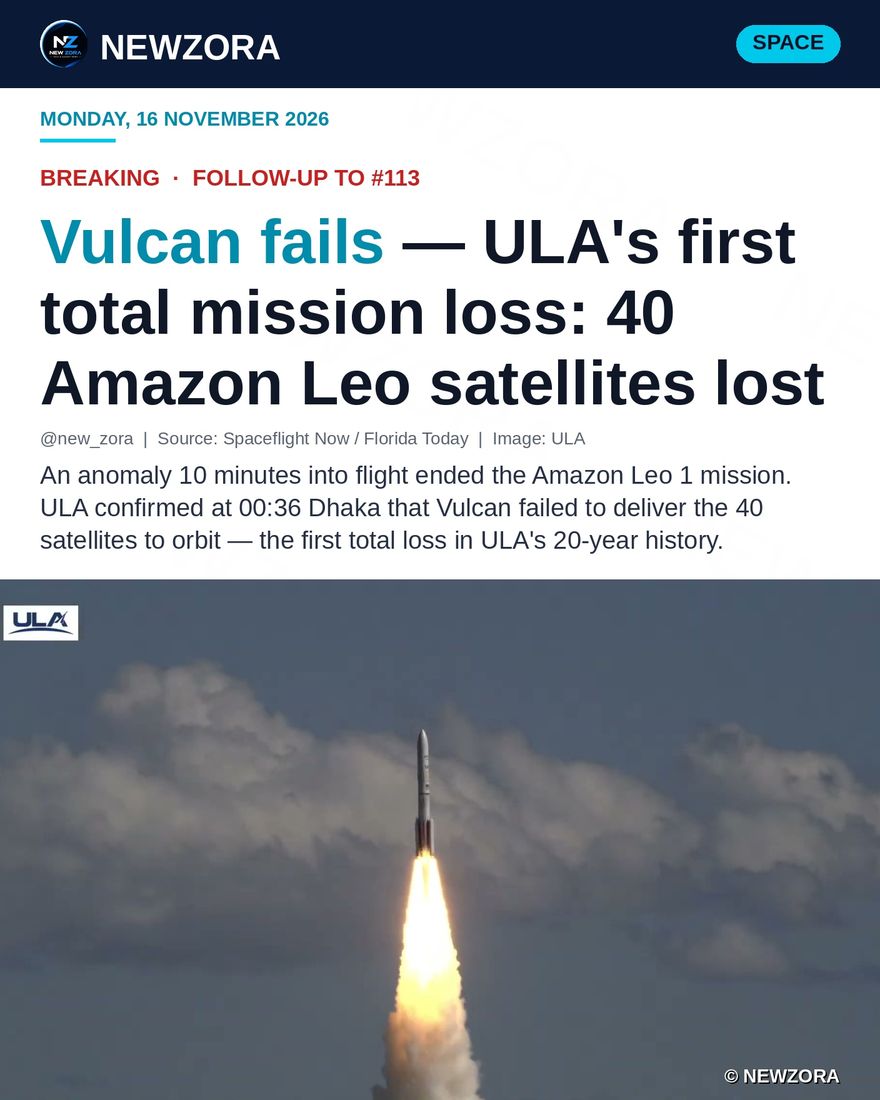
Vulcan fails — ULA's first total mission loss: 40 Amazon Leo satellites lost
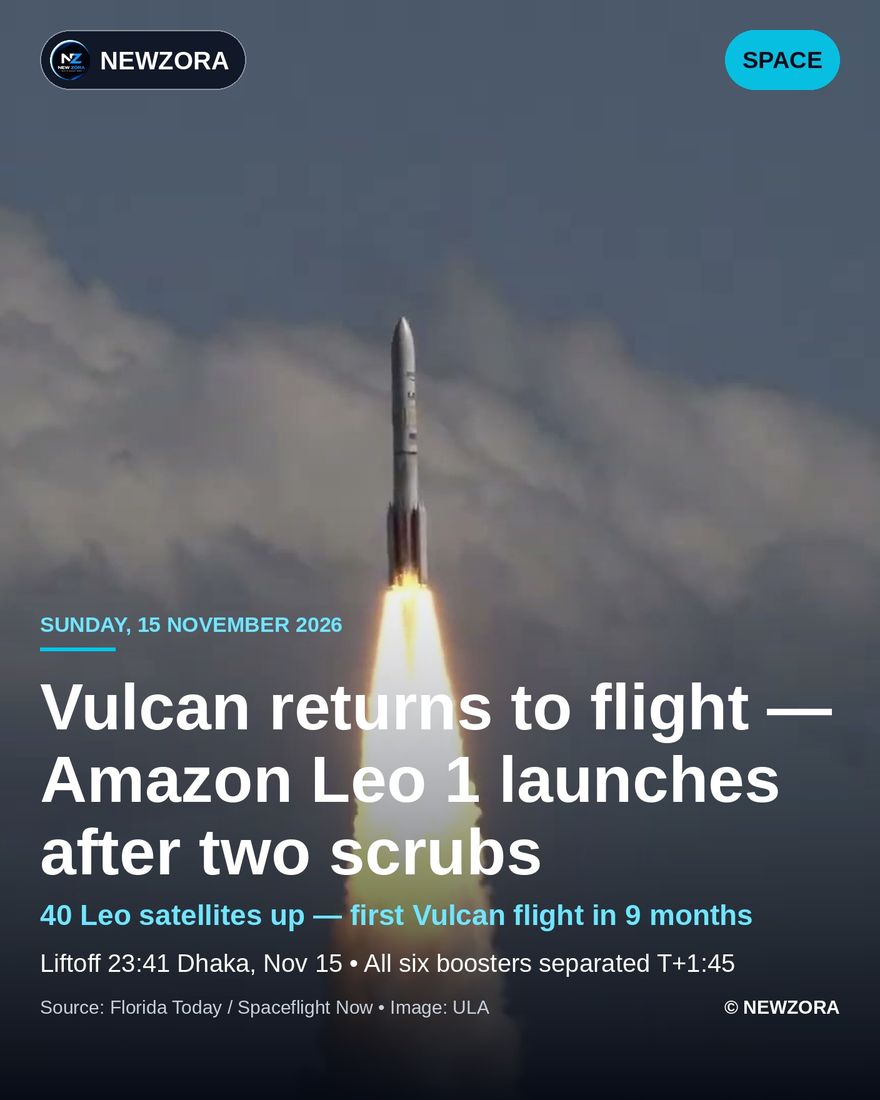
Vulcan returns to flight — Amazon Leo 1 launches after two scrubs