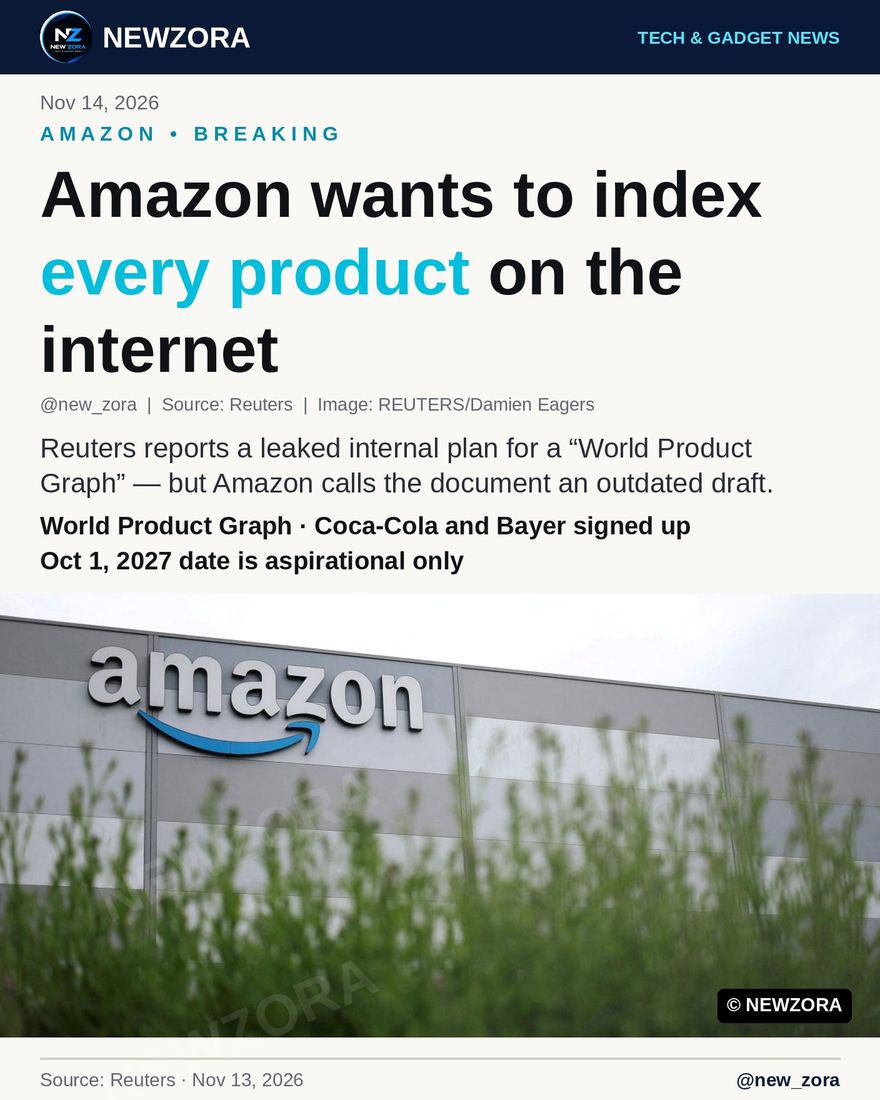
Amazon wants to index every product on the internet
The document and the World Product Graph
The document reviewed by Reuters describes a graph of product data covering items sold anywhere, including items that Amazon does not carry. The stated purpose is to give Amazon a comprehensive record of products, their attributes and their relationships to one another. The project sits inside Amazon's Selection and Catalog Systems unit, which is led by vice president Robert Tekiela, and Reuters reports that Amazon is moving staff internally to advance it.
The document frames the project as an expansion of services that Amazon already operates, including "Buy for Me" and "Shop Direct". Those services allow Amazon's shopping assistant to buy items from other retailers on a customer's behalf. The World Product Graph would supply the underlying product data for that kind of transaction, and for the assistant itself.
Why Amazon wants the data
The document gives two reasons for the project. The first is that shoppers leave Amazon to research products elsewhere. The document states: "Amazon cannot be the go-destination for every shopping mission if customers must leave to research product relationships on Google, brand websites, and review sites." The graph is intended to keep that research inside Amazon.
The second reason concerns the accuracy of Amazon's shopping assistant. The assistant was originally called Rufus and was renamed "Alexa for Shopping" in May 2026. The document states: "Many Rufus answers are factually wrong or incomplete, but customers lack expertise to detect these errors." A comprehensive product graph would, in the document's framing, improve the quality of the assistant's answers by grounding them in structured product data.
The companies named in the document
According to the document, two large consumer-goods companies have agreed to contribute product data to the project. Coca-Cola and Bayer have signed up to supply data, as described in the document. Amazon also held a summit at chief-executive level with Procter and Gamble to discuss a trial with that company.
The companies named did not respond to Reuters when the news agency sought comment. Their participation is therefore described here only as the document describes it. No confirmation from Coca-Cola, Bayer or Procter and Gamble has been reported.
The date and the limits of the evidence
The document lists 1 October 2027 as a release date for the project. Reuters reports that this date should be treated as aspirational only. The news agency states that it "could not determine if or when this plan may be implemented" and that it "could not determine if the October 1 date is a realistic deadline". The date is therefore not a confirmed launch date, and it must not be read as one.
Reuters also cautions that the project may never reach customers. The news agency notes that not all PR/FAQ documents lead to a service being introduced, and that the project "could be modified or aborted". The document is an internal planning artefact, and its existence does not establish that Amazon has committed to building the product it describes.
Reuters further reports that it could not determine how Amazon planned to gather data for the graph, or whether permission from other retailers would be required. No claim about the method of data collection is made here, because the reporting does not support one.
Amazon's response
Amazon responded to Reuters with a statement that disputes the currency of the document. The company said: "Draft, outdated documents often paint an incomplete picture and the existence of a brainstorming document such as this one doesn't necessarily reflect our current plans." Amazon added: "We're constantly working on new ideas and technologies to make Amazon's product catalog comprehensive, accurate, and helpful."
The statement does not confirm the project, and it does not deny that the document exists. It presents the document as a brainstorming artefact that may not reflect current planning. That framing is the company's position, and it stands alongside the reporting rather than replacing it.
The competitive context
The report arrives during a period of intense competition over shopping powered by artificial intelligence. A Morgan Stanley report published in 2025 found that only 16 percent of online shoppers begin product research on Amazon, compared with 57 percent on Google. The same report found that when shoppers already know the exact product they want, 41 percent start on Amazon, compared with 23 percent on Google and 18 percent on Walmart. Those figures describe where shoppers start their research, not market share, and they are from 2025.
Rival systems have moved quickly. Meta's Muse shopping agent has attracted more than 10 million users in the United States and Canada since its launch in September 2026. Amazon blocked Muse from its retail site in September and has sued Perplexity, another maker of an artificial intelligence shopping agent. Amazon's chief executive, Andy Jassy, has said that Alexa for Shopping was used by more than 400 million people in the past year. The World Product Graph, as described in the document, is Amazon's answer to that competition: a data asset that would allow its own assistant to answer shopping questions without sending customers elsewhere.
What comes next
The immediate question is whether the project advances beyond the document stage. Reuters could not determine a timetable, and Amazon has not confirmed one. The document's date of 1 October 2027 is aspirational, and the project could be modified or abandoned before then. Further evidence would take the form of public announcements, regulatory filings or statements from the companies named in the document. Until such evidence appears, the World Product Graph remains a reported internal plan, described by Reuters and characterised by Amazon as a draft.
Sources: Reuters (13 November 2026, Greg Bensinger); The Verge (13 November 2026); Storyboard18 (14 November 2026).