
Reuters: Jensen Huang had a relationship with a second Nvidia employee
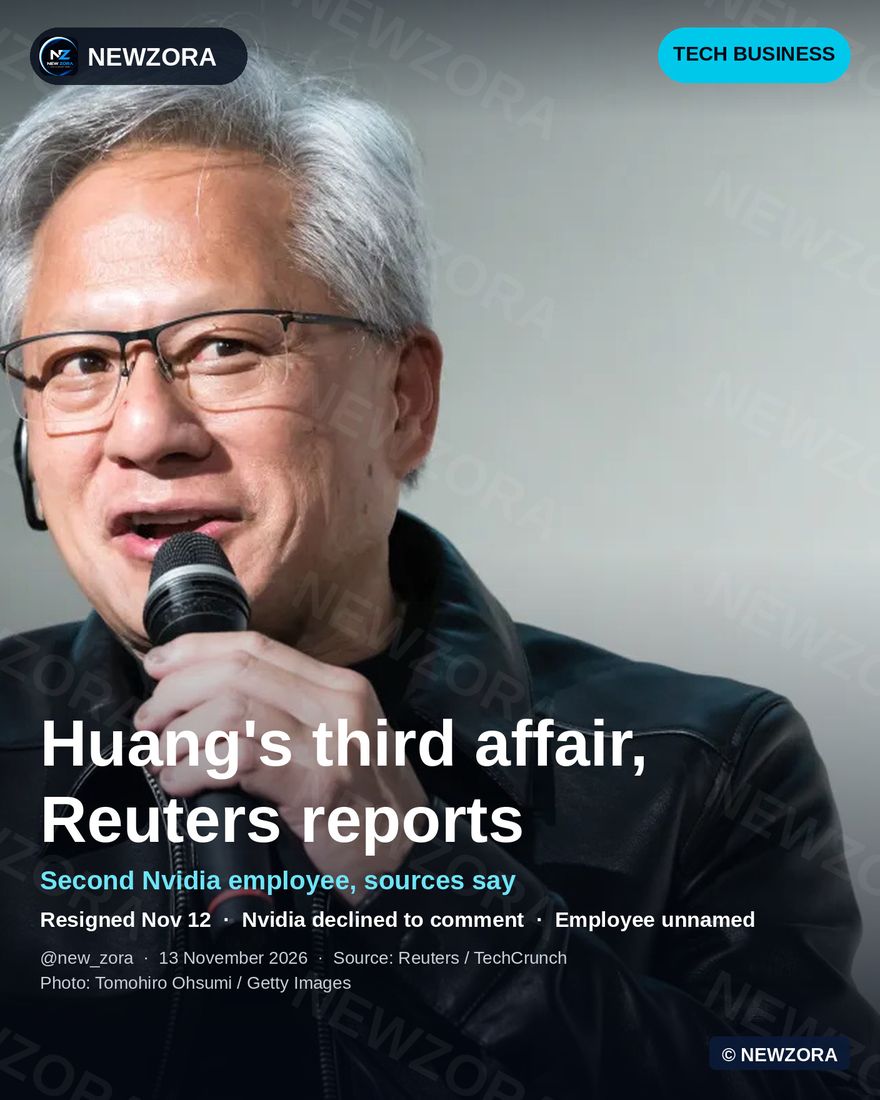
The allegation has not been confirmed by Nvidia, by Huang, or by the employee concerned. It rests on the accounts of two people familiar with the matter, as reported by Reuters. The distinction matters: what follows is a report of an allegation, not an established finding, and the company has declined to comment on it.
The second employee
The second employee has not been named. Reuters stated that it is not naming her and that attempts to reach her were unsuccessful. No further identifying detail was published, and no separate account of the relationship has been made public.
Nvidia declined to comment on the report. Huang did not reply to a request for comment. Kimberly Powell, Nvidia vice president of health care, did not reply to a request for comment, and a representative for the board of Nvidia also did not reply.
The report describes the relationship as intimate. It does not state when the relationship began, how long it continued, or whether it overlapped with the other two relationships that preceded the resignation. Those details were not disclosed in the reporting, and no document or statement has been published that would answer them.
The two earlier affairs
According to Reuters, the report of a second employee follows two other extramarital affairs that led to the resignation announced on Thursday, November 12, 2026. The first involved Alice Huang, a Singapore-based businesswoman. United States intelligence suspects that Alice Huang has links to Chinese intelligence. Beijing has denied that she is a spy. The suspicion has not been presented as a proven fact by any official source, and it should not be read as one.
The second involved Kimberly Powell, Nvidia vice president of health care. That account rests on a report by The New York Times, which cited five Nvidia employees. Nvidia, Huang, and Powell have not confirmed it. The absence of confirmation is itself part of the record: the allegation exists in published reporting, and the parties named in it have not verified it.
Huang admitted to an affair in a statement to Nvidia employees on November 8, 2026. The statement did not refer to any woman by name, and it did not specify which relationship it concerned. The admission therefore establishes that an affair took place, while leaving the identity of the person involved unstated.
The resignation and the investigation
Huang resigned on November 12, 2026, with immediate effect, ending a tenure of 33 years. He co-founded Nvidia in 1993 and led the company through its rise from a graphics processor maker to the most valuable supplier of the artificial intelligence hardware on which the current boom depends.
The board of Nvidia has appointed the law firm Wachtell, Lipton, Rosen and Katz to conduct an independent investigation. The scope of that investigation has not been made public in full, and no timetable for its findings has been announced. An independent investigation of this kind typically examines whether company policy was breached, whether any conflict of interest affected business decisions, and whether the board was informed at the appropriate time. None of those questions has been answered in public so far.
The disclosure also follows Huang's recent testimony before Congress, which placed the company and its chief executive under formal scrutiny in the same period. The sequence of events — testimony, admission, resignation, and now a further report — has compressed into a period of days a set of questions that would normally be examined over months.
Leadership transition
Colette Kress, the chief financial officer of Nvidia, has been appointed interim chief executive. Harvey Jones has become the first independent chairman of the board. The appointments were made as part of the transition announced with the resignation, and both take effect immediately.
The leadership change arrives at a moment when Nvidia occupies a central position in the global market for artificial intelligence computing. The company supplies the accelerators used to train and run the largest models, and its quarterly results have become a reference point for the wider technology sector. A change of chief executive at such a company carries weight beyond the company itself, because investors, customers, and competitors all read it as a signal about stability and direction.
Why it matters
The significance of the report lies in three areas. The first is governance. A chief executive in a relationship with an employee raises questions about power, consent, and conflicts of interest that corporate policy exists to manage. Whether any policy was breached is a question for the independent investigation, not for speculation, but the existence of a third reported relationship widens the scope of what that investigation must examine.
The second is disclosure. The public record now contains an admission of an affair, two reported relationships, and a third allegation from two people familiar with the matter. The gaps between those accounts — what was admitted, what was reported, and what remains undisclosed — are themselves material to shareholders, because they determine how much of the episode is understood and how much is still unknown.
The third is the position of the unnamed employee. Reuters has chosen not to name her, and that decision reflects a standard consideration in reporting of this kind: the privacy of a person who has not spoken publicly. Any further reporting should preserve that restraint unless she chooses to speak.
What happens next
The independent investigation by Wachtell, Lipton, Rosen and Katz is the next formal step. Its findings, if published, will establish whether company policy was breached and whether the board acted on the information available to it. Until then, the public record consists of the Reuters report, the earlier reporting by The New York Times, the admission of November 8, and the resignation of November 12.
Further reporting may establish the details that remain unknown, including the timing of the relationship and whether it had any bearing on business decisions. It may also establish nothing further, if the people concerned do not speak and the investigation remains confidential. Either outcome is possible, and the record should be read as it stands: a serious allegation, attributed to two people familiar with the matter, denied comment by the company, and awaiting independent examination.
Source: Reuters, November 12, 2026; The New York Times; Firstpost. This article is a follow-up to Newzora reporting on the resignation of Jensen Huang and his testimony before Congress.