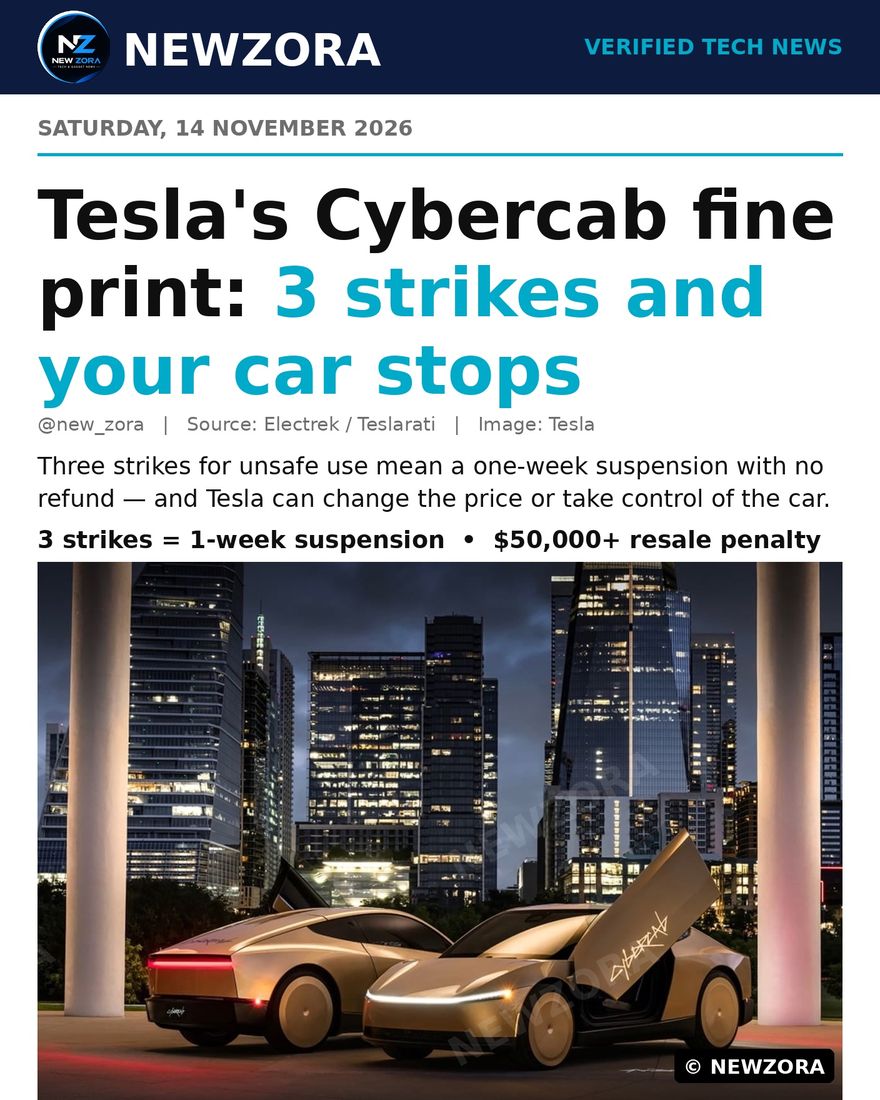
Tesla's Cybercab fine print: 3 strikes and your car stops
A subscription, not a conventional purchase
The Cybercab is sold as a vehicle with an autonomy subscription attached. According to Electrek, which first reported the agreement, the subscription is mandatory for operation of the vehicle, and the first month is included in the purchase. The order screen lists the subscription at 299 dollars per month. That figure does not appear in the agreement text itself, and the distinction matters: the agreement governs the price, while the order screen states the current figure. Tesla reserves the right to change the subscription price with one month of notice to the owner. A buyer who objects to a future increase therefore has limited recourse beyond cancelling the subscription, which would leave the vehicle unable to operate autonomously.
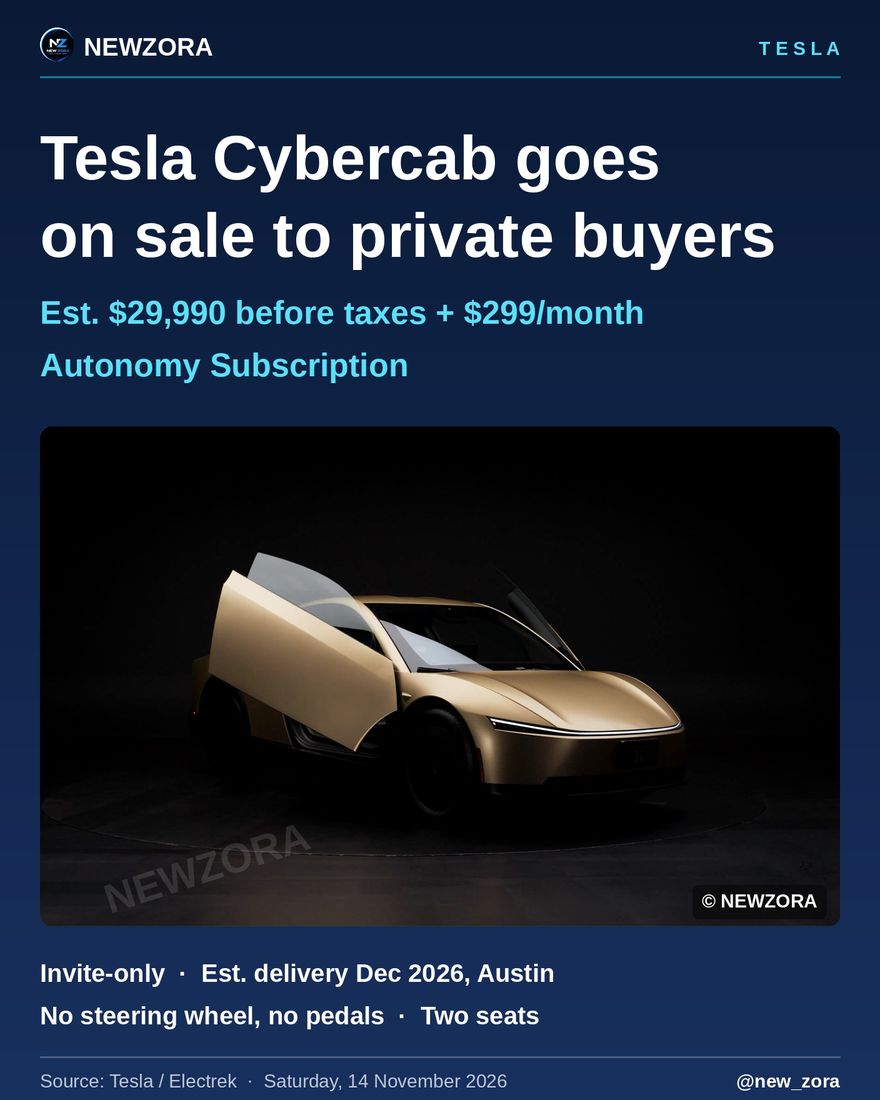
The background to the agreement is the order programme announced the previous day. Tesla opened invite-only orders for the Cybercab on 13 November 2026, at a price of 29,990 dollars before taxes, with a 1,000 dollar non-refundable deposit and estimated delivery in December 2026 in Austin. The agreement is the document that converts that reservation into a set of binding operating conditions.
Three strikes and a one-week suspension
The most consequential provision in the agreement is the strike system. According to Electrek, three or more strikeouts for improper or unsafe use of the vehicle trigger a suspension of the autonomy subscription lasting one week. The suspension carries no prorated refund. In practical terms, an owner who accumulates three strikes loses autonomous operation for seven days while continuing to pay for the subscription.
The agreement does not define the full list of behaviours that constitute a strikeout in the excerpts reported to date, and Tesla did not disclose a public appeals process. Teslarati, which also reviewed the document, reports the same three-strike threshold and the same one-week duration. The structure mirrors strike systems used by ride-hailing platforms, but its application to a privately owned vehicle is unusual: the owner has paid for the car, yet the right to use its defining capability can be withdrawn temporarily for conduct Tesla deems improper or unsafe.
Resale and transfer restrictions
The agreement places tight limits on what an owner may do with the vehicle after purchase. Resale or transfer of the Cybercab requires the written permission of Tesla. An owner who transfers the vehicle without that permission faces damages of at least 50,000 dollars. Tesla also retains a buyback right at a value determined by the company. The practical effect is that the secondary market for the Cybercab is controlled by Tesla, not by the owner. A buyer cannot assume that the car can be sold onward at market value, or at all, without Tesla's consent.
The agreement also restricts modification. Owners may not apply wraps, tint, or wheel changes except through Tesla or an authorised provider. The restriction is consistent with the vehicle's sensor-dependent design: the Cybercab carries cameras and sensors whose field of view could be affected by aftermarket changes. It also means that personalisation options available to owners of conventional Teslas are substantially narrower for the Cybercab.
Remote control retained by Tesla
The agreement grants Tesla extensive remote powers over the vehicle. According to the reporting, Tesla can remotely locate the car, restrict its operation, take control of it, or place it in a safe state. The company did not disclose the precise circumstances under which it would exercise these powers in the excerpts reported, beyond the context of improper or unsafe use and the operation of the strike system. The provision is a reminder that the Cybercab is a connected vehicle whose operation depends on Tesla's network and software, and that the owner does not hold exclusive operational control.
Where and how the car may be driven
Operation of the Cybercab is limited to Tesla-enabled Robotaxi geofences. Tesla may expand, reduce, or relocate those geofences. An owner therefore cannot assume that the vehicle will operate autonomously in any given location at any given time, even if that location was inside a geofence at the time of purchase. The agreement states that use is for personal purposes only.
Manual control is severely limited. The vehicle may be driven manually through touchscreen controls only up to approximately 2 miles per hour, and only by a person holding a valid United States licence. The Cybercab has no steering wheel or pedals, so manual operation is a low-speed manoeuvring function rather than a driving mode. Vehicles are delivered with approximately 250 miles on the odometer, reflecting road testing before handover, and charging is limited to the North American Charging Standard. Owners cannot charge the vehicle from a non-NACS connector without an adapter, and Tesla did not state whether such an adapter would be supported.
Why the terms matter
The agreement establishes a model of vehicle ownership in which the manufacturer retains continuing authority over the product after sale. The three-strike suspension, the transfer restrictions, the modification limits, and the remote-control provisions together mean that the Cybercab is closer to a licensed service than to a conventional car. The 299 dollar monthly subscription, the one-month repricing notice, and the absence of a refund for suspension periods add a recurring financial exposure that does not exist for a standard vehicle purchase.
None of this makes the Cybercab an unviable product. The vehicle is the first mass-market car designed without a steering wheel, and its economics depend on Tesla operating it as part of a managed fleet. The agreement reflects that design choice. Prospective buyers should weigh the terms against the convenience of a driverless vehicle and decide whether the restrictions are acceptable. What is certain is that the headline price of 29,990 dollars does not capture the full cost or the full set of conditions attached to ownership. The agreement, not the order screen, is the document that defines them.
Source
Electrek; Teslarati; Paul Tan; TeslaNorth. The agreement cited is the Tesla Cybercab Autonomy Subscription Agreement, version 20261112, published on the Tesla configurator on 13 November 2026. The 299 dollar monthly subscription figure appears on the order screen, not in the agreement text.